
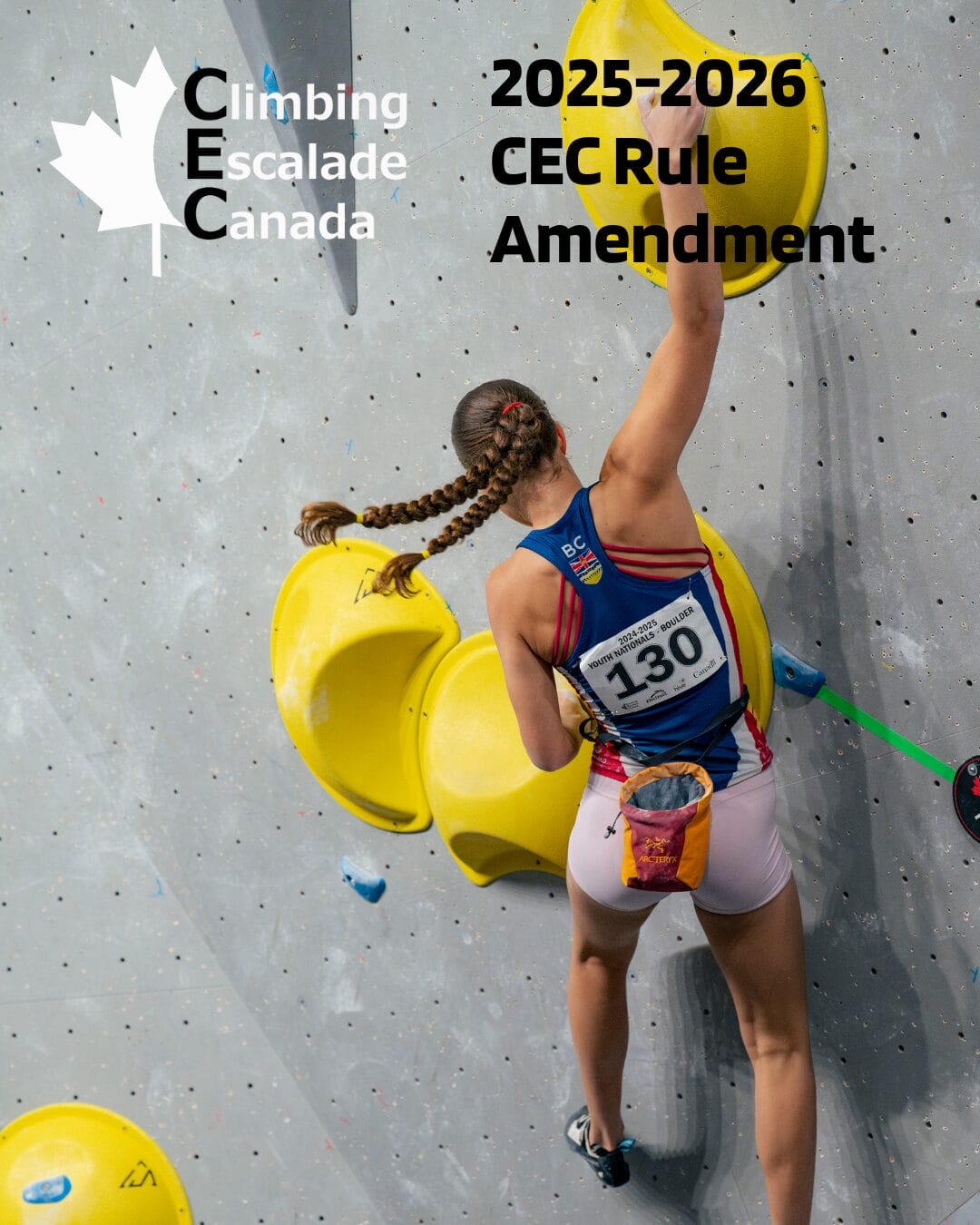
As we gear up for another exciting competition season, CEC has completed its annual review of the sport climbing rules. This blog post walks you through how the review works, how we align with World Climbing (previously IFSC), and what changes are coming for 2025–2026.
2025-2026 CEC Rules Amendments
CEC and World Climbing Rules: How They Work Together
CEC fully supports and follows the principles of World Climbing Rules. These international standards guide how our sport is practiced and judged around the world.
In reality, however, some World Climbing rules simply can’t be applied directly in Canada due to capacity limits or the structure of our federated system. When this happens, we introduce Canadian amendments—small adjustments that allow competitions to run fairly and consistently across the country.
For example: World Climbing uses World Ranking to seed athletes (“Event seedings will be determined from the World Ranking”). In Canada, we don’t have a national ranking system that spans all provinces, and provincial results aren’t directly comparable across jurisdictions. Because of this, CEC uses randomized seeding when creating National event start lists.
This is one of several situations where Canadian-specific adaptations are necessary to keep events fair and workable.
A Major World Climbing Rules Overhaul in 2025
At the start of 2025, World Climbing released a significant update to its rules and regulations. Previously, all rules were housed in one document — almost 100 pages long. Earlier this year, World Climbing has reorganized its framework into five separate documents:
- World Climbing Rules 2025
- World Climbing Eligibility Code
- Competition Regulations at Climbing Events
- Competition Regulations at Para Climbing Events
- World Climbing Uniform Code
In response, the CEC Technical Committee conducted a full review of each document. Every clause was analyzed, discussed, and assessed for suitability in the Canadian context. Our guiding principle for this cycle was clear: stay as close as possible to the World Climbing Rules, and only amend when necessary.
How to Use the CEC Rules Amendment Document
The CEC Rules Amendment Document is designed to be read alongside the World Climbing Rules and Regulations documents.
For each section of the World Climbing framework, the CEC document clearly indicates whether a modification is required, and what the Canadian amendment is. This approach keeps everything transparent and easy to navigate for athletes, coaches, officials, and organizers.
Key Changes for the 2025–2026 Season
The 2025–2026 CEC Rules Amendments include updates driven by the new World Climbing framework, as well as changes made in response to feedback from our community. While we recommend all athletes and coaches to be aware of all the rules and regulations, here are some highlighted changes coming this season.
A – Official Introduction of the 2025 Boulder Scoring System
For the 2025–2026 season, CEC is adopting the new World Climbing bouldering scoring format. Instead of awarding “Zone” and “Top” and displaying results like 4T 2Z, the new system assigns numerical point values to each scoring hold. Athletes will now receive a final numerical score (for example: 124.5).
Here’s how the new scoring works:
- Zone = 10 points
- Top = 25 points
- Each unsuccessful attempt = –0.1 points
This update does not change how boulders are judged in terms of control, use of holds, or movement requirements. It only changes how the score is calculated and displayed. On the wall, instead of “Zone” and “Top” labels, you will now see markers showing 10 and 25 to indicate the point values of those holds.
B – Communication During Boulder Flash Format
Beginning this season, CEC will align fully with the World Climbing approach to communication during Flash Format rounds (qualification rounds). There will be no restrictions on when or what may be communicated to athletes while they are on the wall or on deck.
This topic has sparked debate over the years, and we want to share the key principles that guided our decision:
- Judges are volunteers. Their primary responsibility is to fairly and accurately judge the climb. Expecting them to monitor, control, or “police” communication in the crowd is both unrealistic and unfair, and distracts from their essential role.
- Communication is already permitted in Lead and Speed Flash Formats. There is no reason for Boulder to operate differently. When a round is not run in an Isolation Format, communication standards should be consistent across all disciplines.
- World Climbing events permit communication. At Youth World Championships and other World Climbing competitions, coaches and athletes are free to communicate during the climb. There are no restrictions in place during flash rounds.
- Consistency matters. Canadian National events serve as qualifiers for international competitions. Aligning our rules with World Climbing ensures that athletes and coaches are operating under familiar conditions and are better prepared when they step onto the international stage.
Some may feel that these changes move our sport away from “the true spirit of climbing.” We understand that change can be challenging. However, sport evolves — and so must we. Aligning with our International Federation ensures that Canadian athletes and coaches are operating under the same standards used worldwide. This consistency supports athlete development, reduces confusion, and creates a smoother transition between domestic and international competition environments.
C – Speed Ranking Update
World Climbing has introduced an important change to Speed Rankings related to false starts. Previously, an athlete who false started during qualification was automatically disqualified from the rest of the competition.
Under the new rule, as long as an athlete has at least one valid time, a false start will no longer remove them from the ranking. Instead, that athlete will simply be placed at the bottom of the qualification ranking, ordered among other false starters by their second valid run.
This means that an athlete with a false start could still, in some cases, advance to the Knockout Round. This update is particularly relevant in Canada, where participation numbers in Speed are often smaller.
Imagine a Speed qualification round with 16 athletes.
- Old rule: If one athlete false started, they would be disqualified. Only 15 athletes would have valid results. Because finals can only progress in rounds of 16, 8, or 4, only 8 athletes could move on. This means 7 athletes would be eliminated.
- New rule: The athlete with the false start would be ranked 16th, but as long as they have one valid time, they remain eligible for the Knockout Round. As a result, all 16 athletes can move forward, maximizing participation and ensuring a fair progression system.
This change aligns Canadian competition formats with World Climbing standards while ensuring more inclusive and consistent advancement for athletes.
If you have questions, need clarification, or would like to provide feedback, we encourage you to reach out via info@climbingcanada.ca. Your input helps us ensure Canadian climbing competitions remain fair, clear, and athlete-centered.
